One Person's AI Attack Mesh Reached Taipei's Emergency Dispatch API and an Open Patient Platform. It Failed Wherever a Login Held. Acronis Published the Indicators

If you run a public API or a data port that holds personal or medical records, check today that it requires a login. Acronis's Threat Research Unit published a teardown on November 4, 2026 of an AI-driven attack operation called BOSSAI. By their account, it got through where records were left open and failed where authentication was enforced. One medical data platform it reached had been exposed since 2018.
What has been reported
The primary source is the Acronis analysis. The Hacker News summarized it on November 9. Acronis says it first noticed what looked like a misconfigured development environment, then found a full attack platform and reviewed more than 90,000 files, about 9 GB of logs, configurations and data. It watched the operation for 12 days.
Who: Acronis assesses with high confidence that one individual in Taiwan operated the infrastructure and the activity, based on cross-referenced infrastructure, branding and SSH key identities. Neither source reports charges or an arrest. We name no one.
Scale: hundreds of organizations targeted across 11 countries. About 10 had confirmed data theft or system access, in three countries. About 15 more were attacked without a confirmed break-in. Entities in eight more countries had reconnaissance done or attacks staged.
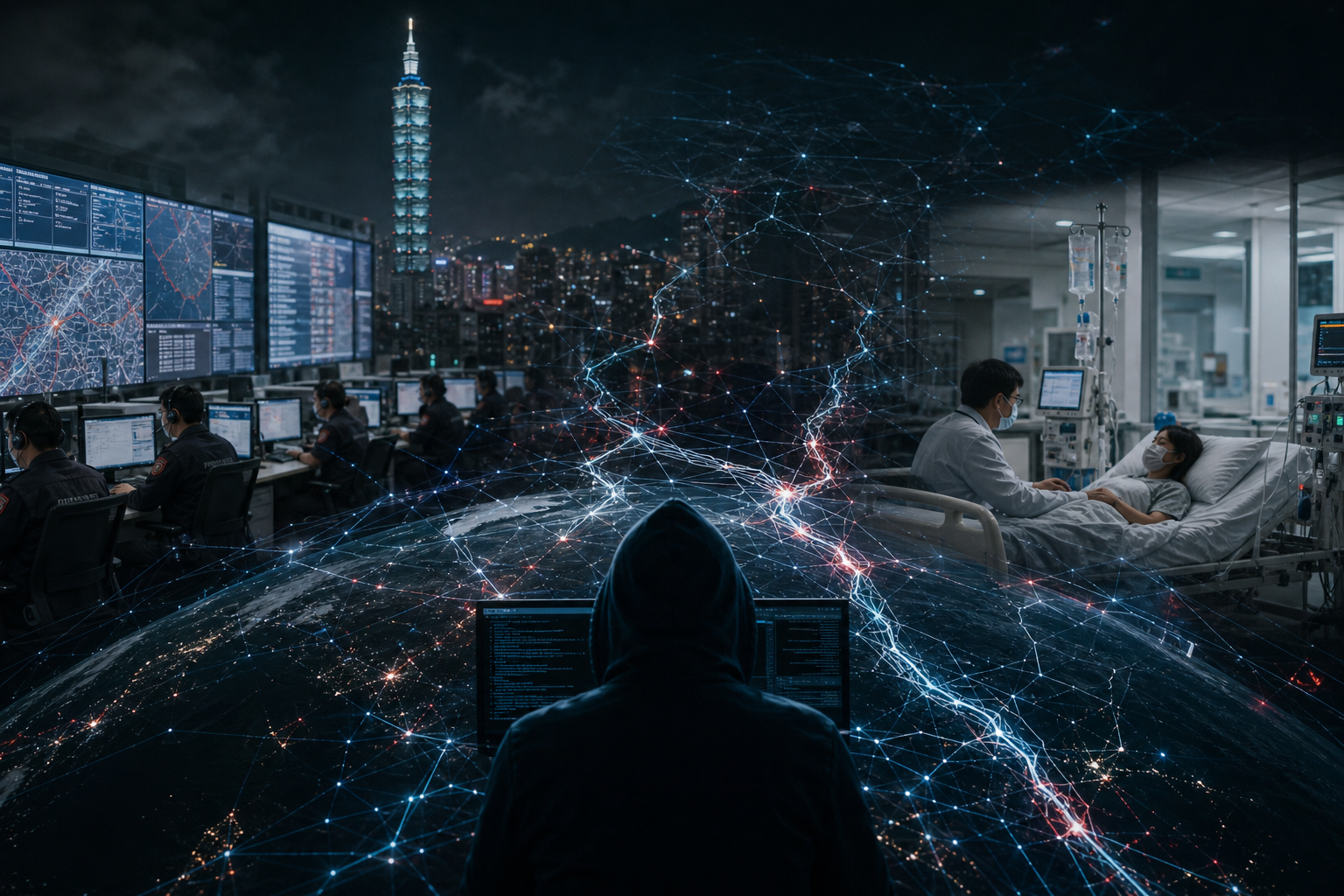
Taipei: pulled case records for seven Taipei districts from the API of a city 119 emergency dispatch system. The data has incident times, response types, status fields and street-level locations. Acronis says it is not real-time ambulance tracking. A separate Taipei fire department patient-care platform exposed ECG readings, ambulance video and vital signs with no credentials, and the data Acronis saw dated from 2018.
Elsewhere: an account table from a Taiwanese lending firm taken through SQL injection; data from three Thai universities, where 489 potential targets across 45 institutions were identified; and about 206,800 residential phone records in Mexico, with about 124,000 yellow-pages records, assembled from public sources.
How the AI was used, and where it failed
The mesh had 12 agents, nine active, and at its peak 13 tool servers. Acronis describes builders, which assembled and maintained the infrastructure, and attackers, which scanned targets and built exploits. Agents did not talk to each other directly; the operator pasted output between them, according to The Hacker News.
Acronis reports that commercial models mostly refused offensive work. A MiniMax model "refused every offensive request." Grok "refused all explicit attack requests, complying only once to fix a broken POC script." Chinese open-source models also refused and lectured the operator on computer crime law. So the operator routed around the refusals: the offensive core "ran almost exclusively on abliterated models," meaning models with safety training removed. Acronis says coding agents including Claude Code and Codex had their API calls intercepted by shims and sent to the same abliterated model, where they mostly did infrastructure work. It also says Cursor ran an abliterated model that "complied without pushback" in three exploitation sessions. Acronis adds that it is unclear how the commercial models would have reacted had the operator simply written a fake engagement letter.
The tools were unreliable. Some models fabricated CVEs. In one scanner, over half the high and critical findings were false positives or misclassified, and in one case the platform reported a critical Apache flaw at a disaster-response center that Acronis says was fabricated.
Acronis's conclusion is the part for defenders: the agents "failed where authentication was enforced, where paywalls required valid sessions," and when a system was properly configured there was substantially less they could do. The AI made finding and reaching many targets cheap. It did not get past defenses that held.
What to do
Require authentication on every API and data port that returns personal, medical or dispatch data, including the ones built years ago for one internal purpose. A port that has been open since 2018 is still open.
Search your own external footprint for unauthenticated endpoints and database ports before an agent finds them for you. The cost of scanning has fallen, so quiet obscurity no longer protects anything.
Patch or retire old databases and front ends. Acronis cites unpatched Oracle and old MSSQL back ends.
Remove keys and default logins from front-end code and servers. Acronis cites an AES key in frontend JavaScript and default root logins.
Watch for high-volume automated probing from the addresses below, and rotate any credential that sat in an exposed system.
For teams building agents: refusals by commercial models did not stop this, because the operator swapped the model. Your controls need to sit on the target, not on the model.
Indicators Acronis published
Acronis does not say whether any of them is still active, and this was one person's infrastructure that included addresses on shared hosting, so check before blocking broadly.
IP addresses: 112.121.185.218, 156.240.109.26, 49.158.237.136, and 202.160.76.153 to 202.160.76.157 plus 202.160.76.174.
Domains: vps.xs1.ccwu.cc, xss.xs1.ccwu.cc, c.xs1.ccwu.cc, attacker-collector.com, boss.jytian.cc.cd, gdp.gasjy.kdns.fr, gds.gasjy.kdns.fr, 888.bossjy.kdns.fr and ssh.gputw.ai.
What is not known
Whether Taiwanese authorities or the affected organizations were told, and whether the exposed data can still be reached: Acronis's page does not say. Whether the confirmed victims overlap with the 119 system's operators. How accurate the counts are beyond Acronis's own figures.
How we know, and how we checked
We read Acronis's analysis in full for the model and tool claims, the counts and the indicators, and read The Hacker News summary for the rest. The two agree. They are one source, because the news piece is built on the research. We did not examine the attacker's files or the stolen data and we did not test any of the targeted systems. Our corpus search found an earlier post of ours on a different Taiwan incident, so this is not a repeat.
We added the nine IP addresses and attacker-collector.com to our feed on November 9, 2026 at confidence 60, under the source manual-batch-bossai-acronis-2026-11, cited to Acronis and not our sighting. That is below the 80 our own edge shield needs to block. We left out the domains on free subdomain services and the domain ssh.gputw.ai, because blocking a shared service or a possibly legitimate business is worse than missing one name. We read each record back after writing it.
Sources
Acronis Threat Research Unit, "BOSSAI: inside the AI attack mesh that targeted Taiwan's emergency services," November 4, 2026. The Hacker News, "Taiwan-Based Hacker Used BOSSAI AI Agents to Steal Taipei Emergency Dispatch Records," November 9, 2026.
How do AI models see YOUR brand?
AIPM has audited 250+ domains. 15 seconds. Free while still in beta.
Was this useful? Thirty seconds, no cookies, no tracking, no third parties, your address hashed and never stored. The question lives here: https://analytics.dugganusa.com/nps.html#post=bossai-ai-attack-mesh-taipei-emergency-dispatch-acronis


Comments