One Router in Arkansas Grounded 18,000 Flights. Replacing Every Router and DSL Line That Matters Costs About $0.1 to $0.5 Billion. Washington Is Asking for $50 Billion. Here Is the Math

Fixing the part of the FAA's network that failed on Friday costs somewhere between about $120 million and $320 million, and $500 million if you pay a contractor's top rate with project management on top. Transportation Secretary Sean Duffy says the system will keep failing unless Congress provides $50 billion. Even the most generous version of the network fix is 1 percent of that. This post shows the arithmetic, so you can check it and change the inputs.
What happened Friday
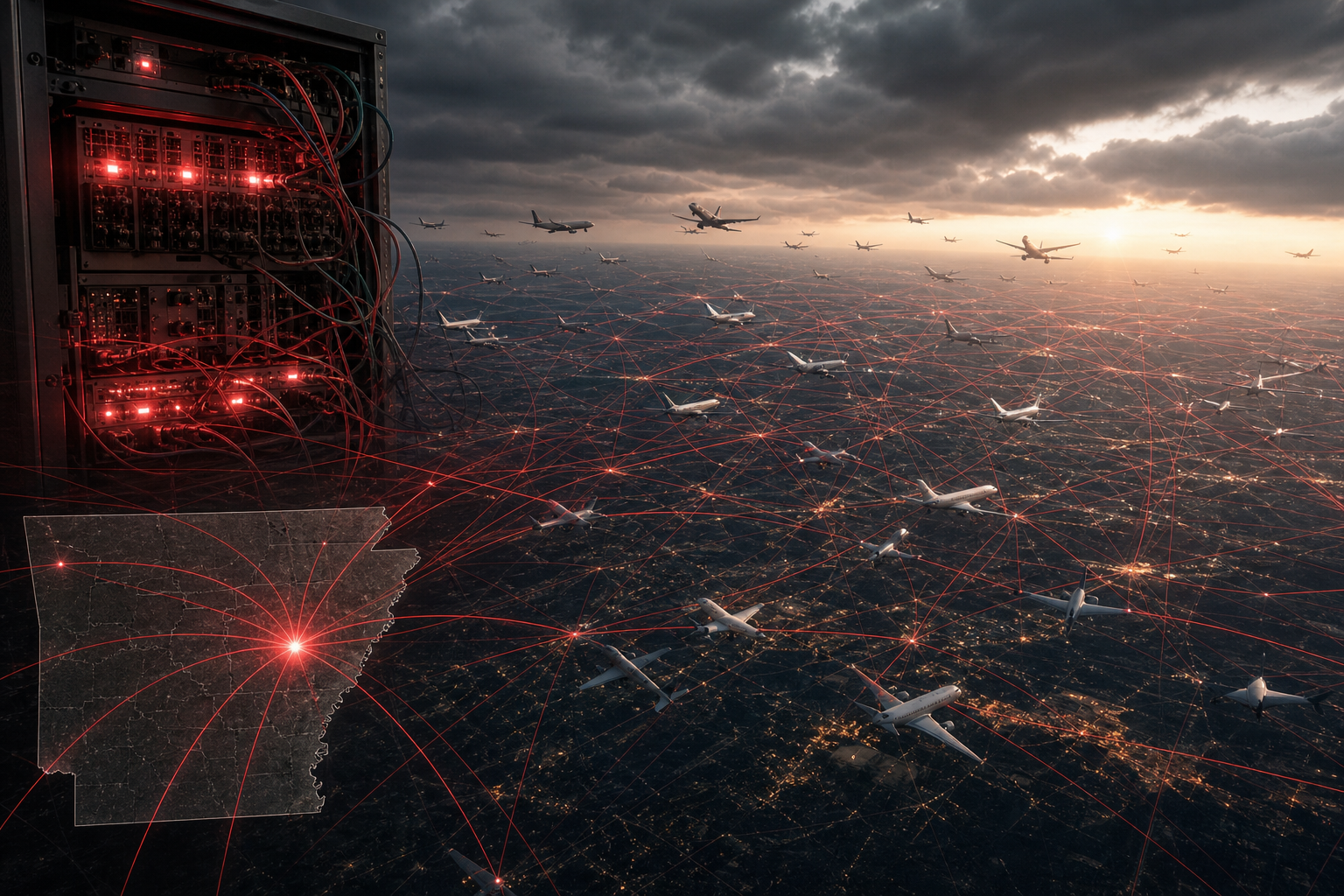
On Friday, November 13, 2026, the FAA stopped flights nationwide for nearly five hours, and more than 18,000 flights were canceled, per CNBC. Duffy said a router L3Harris had installed at a remote facility in El Dorado, Arkansas, "flooded" other routers in the air traffic control network with more than 1,000 connection attempts about every five seconds. He said it disrupted aircraft communications and radar feeds at 17 of the FAA's 22 en route centers. That router and a second one from Amarillo, Texas, are at an L3Harris lab in Florida being examined. The router's maker says its equipment did not fail. Duffy said Monday it is still unclear why the router triggered the stop, and Fox News reported no sign of a foreign cyberattack.
The FAA said L3Harris was installing Juniper routers to replace Cisco routers built in 2001 that were supposed to have been replaced in 2006. L3Harris has run the FAA Telecommunications Infrastructure contract since 2002.
One device sending a flood of connection attempts until the network around it falls over looks like a change that went wrong on a live network: a bad filter, a loop, or a protocol storm, done without the change control and rollback plan that exist to stop exactly that. That is our reading of the public facts, not a finding; the investigation has not said.
What actually needs replacing
The count we are working from comes from public GSA purchasing records: about 600 DSL units (Cisco 600-series, the generation the FAA says dates from 2001) and about 26 pairs of Juniper routers at the core sites. We have not re-verified those counts line by line. Swap in your own numbers; the method does not change.
Why it matters that it is DSL: DSL runs over copper telephone lines, and the phone companies are pulling copper out of service. Equipment that worked for 25 years, slow but steady, is losing the wire it runs on. That is the real reason this cannot wait, and it is a problem of circuits and last-mile construction more than of boxes.
The math
Prices are from reseller listings (CDW and CDW-G) where we could find them, and our estimates where we could not, marked as such.
1. The core: 26 Juniper pairs
We price each pair as a full data-center pod for 10 to 100 gigabit traffic, which is far more than a router pair:
2 spine switches (Juniper QFX5120-32C, 32 ports of 100G): about $31,000 each at CDW. $62,000.
8 leaf switches (QFX5120-48Y, 48 ports of 10/25G with 100G uplinks): about $16,000 to $35,000 each at CDW, call it $22,000. $176,000.
2 edge routers (Juniper MX204 class, 100G): our estimate about $40,000 each. $80,000.
Optics: $40,000 to $120,000.
Software licenses and five years of support, about 40 to 60 percent of hardware: $130,000 to $190,000.
About $0.5 to $0.6 million per pod. Times 26: about $13 to $16 million. Double it for installation, testing and overnight cutovers: about $26 to $32 million.
2. The edge: 600 DSL sites
Each site needs a modern edge device and, because the copper is going away, a new circuit. For remote sites that can mean building fiber, a point made well by a reader whose day job is cloud infrastructure: some sites do not have reliable fiber to the premises at all.
Edge router or SD-WAN device with cellular or satellite backup: $3,000 to $8,000 per site.
Installation and testing: $5,000 to $15,000 per site.
New last-mile circuit build, fiber where it is practical, fixed wireless or satellite where it is not: $25,000 to $150,000 per site, the widest range in this post.
That is $33,000 to $173,000 per site, so about $20 million to $104 million for 600 sites. Add circuits at $1,000 to $2,500 a month per site for ten years: about $72 million to $180 million.
3. Total
Core pods, installed: $26 million to $32 million.
Edge sites, built: $20 million to $104 million.
Ten years of circuits: $72 million to $180 million.
About $118 million to $316 million. Add a 50 percent contractor margin and project management to the high end and you get roughly $475 million, which is where the "$500 million at a high margin, with project management" figure comes from.
4. Against the ask
$500 million is 1 percent of $50 billion.
$320 million is 0.6 percent.
That leaves about $49.5 billion that is not about the routers and DSL lines that failed on Friday.
In fairness to the $50 billion
The modernization program is bigger than this outage. Congress has already given the FAA $12.5 billion for phase one: $4.75 billion for telecommunications, $3 billion for radars and $1.9 billion for new en route centers, among other items, and the Department of Transportation has asked for more. Radars, buildings, controller software and integration all cost real money, and much of the system is old. Our telecommunications figure also fits comfortably inside the $4.75 billion already set aside for telecom.
So the honest question is not whether the FAA needs money. It is why a failure that would cost a few hundred million dollars to fix is being used to justify a $50 billion check, and who is going to spend it. Duffy himself has urged Congress to fund a new telecom network that is not owned by L3Harris, the contractor that ran this one for 24 years and whose installation work is at the center of Friday's failure.
What would actually prevent the next one
None of this is new technology, and none of it is expensive:
Change control on a live safety network: a written change plan, a tested rollback, a maintenance window, and someone watching who can undo it.
Storm control and control-plane protection on every router, so one misbehaving device cannot flood its neighbors. These are configuration settings.
A lab that matches production, so a new router is tested against the old ones before it is plugged into the national system.
Segmentation, so a fault at one remote site cannot reach 17 of 22 en route centers.
A second path for every critical circuit that does not depend on the same copper or the same contractor.
The equipment is cheap. The discipline is what was missing.
How we would buy it
Not as another no-bid award to the incumbent. If we were running the purchase, we would put it through an established government integrator with a track record of federal delivery and minority ownership, such as World Wide Technology, and compete it. The CDW prices above are reference points for the math, not a recommendation of where to buy.
Questions people are asking
What caused the FAA nationwide ground stop on November 13, 2026? Per Transportation Secretary Duffy, a router L3Harris installed in El Dorado, Arkansas, flooded other air traffic control routers with more than 1,000 connection attempts about every five seconds, disrupting communications and radar feeds at 17 of 22 en route centers. Why it did that is still under investigation.
Was the FAA outage a cyberattack? Fox News reported investigators found no sign of a foreign cyberattack. The evidence so far points to an installation or configuration problem on the FAA's own network. We wrote separately about why not every outage is a cyberattack.
How many flights were canceled? More than 18,000, per CNBC, during a stop of nearly five hours.
Who is L3Harris and what is FTI? L3Harris has run the FAA Telecommunications Infrastructure (FTI) contract, the network that carries air traffic data and voice between FAA facilities, since 2002. It was replacing 2001-era Cisco routers with Juniper routers when the failure happened.
How much would it cost to replace the FAA routers and DSL lines? By our math, about $120 million to $320 million including ten years of circuits, and about $500 million at a high contractor margin with project management.
Why is Duffy asking for $50 billion? He says the system will keep failing without a complete overhaul. The overhaul covers radars, buildings, software and telecom; Congress already provided $12.5 billion for phase one, of which $4.75 billion is for telecommunications.
What would prevent another nationwide ground stop? Change control with tested rollback, storm control and control-plane protection on every router, a production-matching test lab, segmentation between sites, and diverse circuits that do not share the same copper or contractor.
What is not known
Why the El Dorado router flooded the network: a configuration error, a firmware fault, a fiber-upgrade problem or something else. The investigation has not reported. Exact equipment counts and models across the FAA network; ours come from public GSA records and are an estimate. How the $50 billion would be split, if Congress provides it.
Sources
CNBC, "DOT Sec. Duffy ties router in southern Arkansas to issues that led to nationwide ground stop," November 14, 2026. Fox News, "Duffy: Investigators examining 2 routers after nationwide FAA ground stop, no signs of foreign cyberattack." Fox Business, "Sean Duffy says L3Harris work may have caused FAA nationwide ground stop." Yahoo News, "L3Harris examining routers at the heart of the FAA meltdown" and "US probes why a router installation sparked mass flight grounding." TeckNexus, "FAA $12.5B Air Traffic Control Modernization." CDW and CDW-G product listings for Juniper QFX5120-48Y and QFX5120-32C. Equipment counts: public GSA purchasing records, our reading, not independently re-verified for this post.
How do AI models see YOUR brand?
AIPM has audited 250+ domains. 15 seconds. Free while still in beta.
Was this useful? Thirty seconds, no cookies, no tracking, no third parties, your address hashed and never stored. The question lives here: https://analytics.dugganusa.com/nps.html#post=faa-ground-stop-router-math-50-billion


Comments